
7 August 2016
The last stop on our Tuscan Chocolate Valley adventures was in fact second last on our list. Hubby and I had not accounted for this……
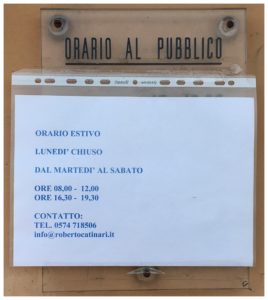 The Italian lunchtime siesta.
This time, we found ourselves outside of Agliana, about 25km west of Florence, in search of the touted “Father of Tuscan Chocolates”.
Along a quiet country road, after several missed turns and u-turns, we finally arrived at the original Arte del Cioccolato……but to closed doors. We had just missed the morning opening hours.
Mental note to self and other chocolate aficionados: Check carefully for Italian opening hours. This information is not always correct on the web.
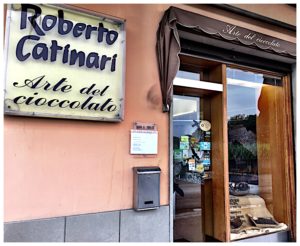
The next day, with 3 hours to spare till our scheduled flight to London, we re-attempt the visit. Success the 2nd time round! We arrive to a shopfront display of the man himself – Roberto Catinari.
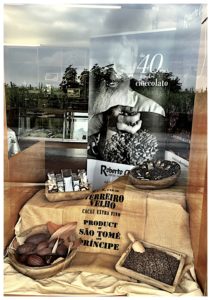 Roberto has spent his lifetime devoted to his passion for chocolates. He started as a teenager in Switzerland, working his way up from dishwasher to the rank of chef in a pastry shop.Then in the 1970s, he decided to return to Tuscany, taking with him his artisanal skills and passion for chocolate making, to open his own shop. Today, more than 40 years on and well into his 70s, Roberto is still going strong and churning out exquisite creations of pralines, chocolate figurines and bars.
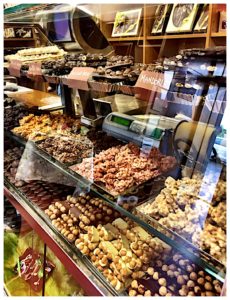 Setting foot into the shop, I am greeted by the ever so inviting aroma of chocolates. The colourful pralines, rochers and bars, behind the gleaming display counter, are a feast for the eyes. The decor isn’t fancy or contemporary. Nonetheless, it wins me over with a sense of warmth and nostalgia.
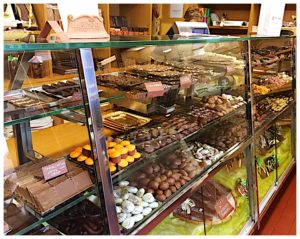 The lovely lady who serves us speaks little English. As the pralines aren’t individually labelled, choosing becomes a tad challenging. Thankfully, we are united in the language of chocolates and find a means to communicate by exchanging names of simple ingredients as we work through our selection.
So, how does chocolate, the recipe and craftsmanship of which have been refined for over half a century, taste?
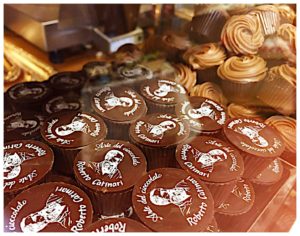 Delicious is an understatement. I am blown away by how good each beautifully hand-made, bite-sized and dainty piece of chocolate tastes. The majority that we selected contain nocciola (hazelnut), either whole, crushed for texture in a praline or as a paste in gianduia. The unique flavours and textures of each are well accentuated.The chocolate itself, made from prized Sao Tome cocoa beans, is rich and smooth with well balanced sweetness.
I rate Roberto’s pralines to be amongst the best that I’ve tasted in Tuscany!
Caught out again by the Italian lunchtime siesta, we miss the opportunity to visit Mannori Pasticceria in Pistoia. We will have to save this experience for our next Tuscan adventure.
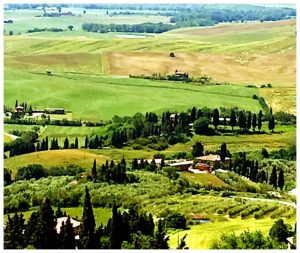 As I bid farewell to the Roberto Catinari experience and our Tuscan Chocolate adventures, I reflect on all that I have learnt and experienced and the chocolate connections that I have made along this journey.
I now truly appreciate how one can spend a lifetime devoted to chocolates, in this little slice of heaven that is Tuscany……
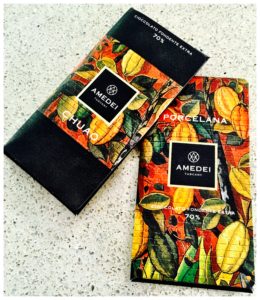 With this knowledge in mind, I sought to find out for myself if the Amedei Porcelana, and its sister bar, the Amedei Chuao, made from prized Criollo cocoa beans derived from the famous Chuao region of Venezuela, lives up to its reputation.
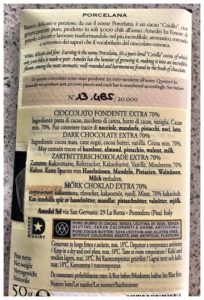 The packaging is attractive and classy. The design is consistent with the Amedei theme, as seen on the painted walls of their headquarters, and the colours bring back fond memories of Tuscany. Each bar is apparently packaged by hand. The number on the back of the Procelana bar tells me that I’ve purchased bar number 13,485 of 20,000 for the year.
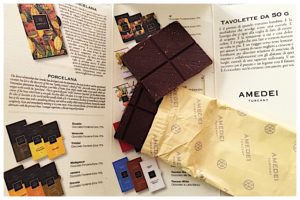 The Porcelana has a slight earthy nose. As it melts on my tongue, I find the texture to be both soft and gentle. The initial flavours are sweet and toasty, like roasted almonds. This gives way to the ever so mild hint of bitterness. And then the flavours disappear, leaving the palate fresh and ready for the next mouthful.
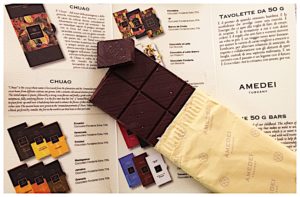 The Chuao is surprisingly different. The aroma reminds me of mushrooms; not quite porcini, perhaps closer to swiss brown mushrooms. As it melts on my tongue, the fruitiness comes through prominently. The closest that I can think of is the flavours of caramelised figs, or Iranian dates. These flavours are slowly replaced by an earthy mushroom finish. Once the chocolate has disappeared, it leaves my palate with a slight but lingering tingle of bitterness.
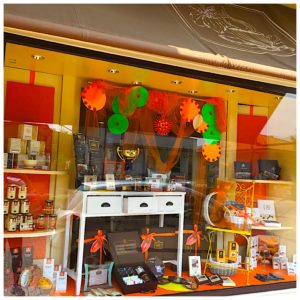 This was the scene that greeted us as we arrived at the headquarters of Andrea and Daniele’s family business, situated just outside the Tuscan town of Monsummano Terme. Originally established by their father, Luciano, as a specialty coffee roasting business, Andrea and Daniele subsequently took over the reigns and expanded the business. Daniele further honed his expertise in blending and roasting coffee while Andrea decided to build on his fascination with chocolate, applying his artistic and creative flair. These days, Slitti Cioccolato e Caffe (chocolate and coffee) is well reputed not just in Italy, but as far away as Asia and Australia, for their quality, award winning chocolates and coffee.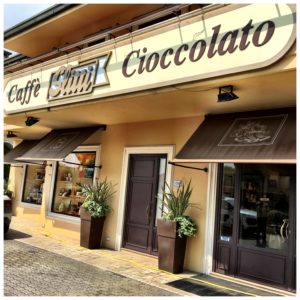
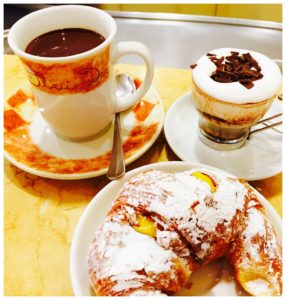 Curbing my enthusiasm for the chocolates that are still to be discovered, hubby and I head straight to the cafe section for breakfast. We place our order for a caffe marocchino and hot chocolate respectively.
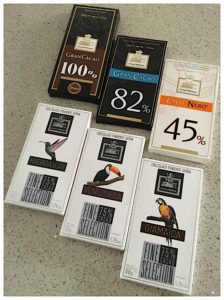 Once sated, we adjourn to the retail section. Where does one start? Systematically, I begin with the award winning ones. The Tavoletta d’Oro (Golden Bar) is acclaimed as the most important chocolate award in Italy, and as a testament to his mastery, Andrea has won a Golden Bar for different creations almost annually since the 2000s (sometimes for the same product over multiple years). He has also been celebrated at the International Chocolate Awards and Salon du Chocolat.
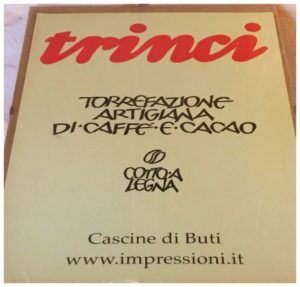 The search for Trinci resulted in hubby and I arriving at the gated entrance to a factory, in a secluded industrial estate in Cascine de Buti, on a cool and rainy Tuscan summer’s day. We were expecting a shop or cafe! Instead, we are greeted by a lone cat. Disappointed and with no help from the website, which is mainly in Italian, I am ready to give up and move on. However, hubby persists and decides to step out of the car to buzz the intercom. Out comes a lady in white uniform. From the passenger seat of the car, I can tell that hubby is struggling to communicate with her. She goes back into the factory, emerging moments later with a small bit of paper. On it is scrawled a name of a shop and a town. Apparently, Trinci’s chocolates can only be purchased in 3 locations, one of which is a shop in the little known town of Bientina. The other two are in Milan and Florence.
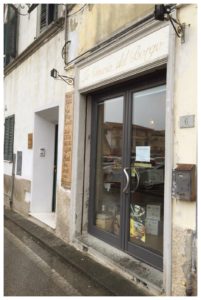 With some renewed vigour, we head there in the rain, in search of Trinci’s creations. Locating the shop is an effort in itself. We walk in to find some Tuscan wines, metal vats of pressed olive oil and regionally harvested honey. Unfortunately, it is slim pickings of Trinci’s chocolates. We are told that the range and quantities stocked are minimal, due to the summer weather. Oh boo:( We purchase a bar each of what’s available – 75% dark chocolate with cocoa nibs and chilli (peperoncino) and 75% dark chocolate with cocoa nibs and Tuscan beach honey (miele della spiagggia).
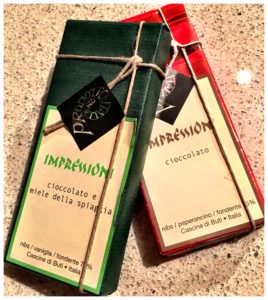 The dark chocolate with chilli bar has the distinct, pleasant, almost sweet aroma of well roasted cocoa beans. I chisel off a small piece and place it on my tongue. It doesn’t melt that easily, due to the high content of ground cocoa nibs. In fact, the nibs mask the ability to truly savour the texture and mouthfeel of the chocolate. And the chilli – there is a lot of it! I didn’t know that Italians had this high a threshold for spiciness. I find the chilli to be over bearing. I would not rate this as a personal favourite.
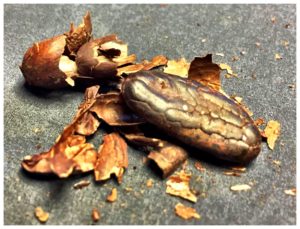 During the roasting process, the shells of the cocoa beans separate from the kernels. The de-shelled kernels are more familiarly known as cocoa nibs. The cocoa nibs are winnowed by air, or using sieves or filters, to completely liberate the nibs from the shells.
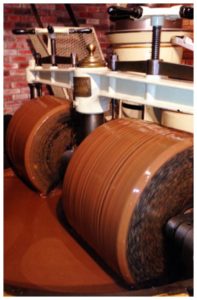 Next, the cocoa liquor mixture is subjected to conching, which is regarded to be the all important step in the development of the flavour, smell and texture of chocolate. The mixture starts as a powdery mass and is kneaded using a machine known as a conche, for a period of several hours to several days. The continuous motion further refines the texture of the mixture and promotes flavour development through a combination of evaporation of volatile chemicals and acids, and oxidation. The end product is the working chocolate.
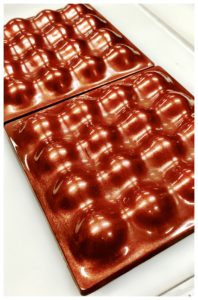 Tempered chocolate is now ready to be moulded into bulk bars, which may then be re-tempered to make finished chocolate bars, blocks, pralines and other moulded chocolates. The tempered chocolate may also go into another production cycle to produce buttons, pellets or blocks of couverture chocolate (which may sometimes be untempered).
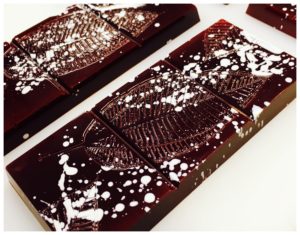 What does “bean to bar” really mean? I trust that this has been clearly explained as we went through the intricacies of the chocolate making process.